



ORGANS OF PARIS © 2026 Vincent Hildebrandt HOME ALL ORGANS



The "Christuskirche - German Protestant Church of
Paris" is attached to the Evangelical Church of
Germany (EKD). The beginnings of the German
Protestant community date back to the 17th century
(official establishment in 1679), when Protestants were
still forbidden to celebrate religious services in Paris. It
was not until 1806 that freedom of religion was
granted by Napoleon.
In the mid-19th century, nearly 70,000 Germans lived
in the city, most of them in poor conditions. The
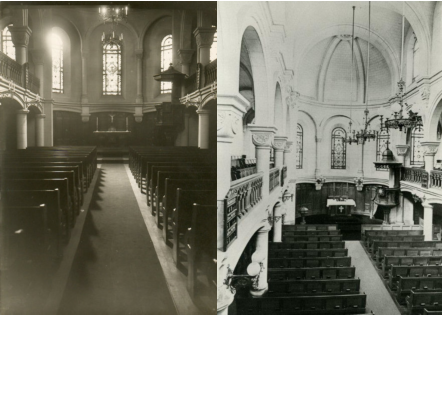
present church was built in 1894 by the German
parishioners of Paris who had previously gathered in
the Lutheran churches of the Redemption and the
Billettes. Immediately, the need to have an organ to
accompany the Lutheran liturgy, dear to Martin Luther,
was felt.
Confiscated during the First World War, it was returned
to the German community in the 1920s and its interior
was completely renovated in the taste of the time.

D1
Its first organ was opus 219 by the German firm Gebrüder
Link of Giengen‑sur‑Brenz. The instrument had originally
been built for the Universal Exhibition in Antwerp
(Belgium) in 1894, where it was awarded a Medal of
Honour. The parish later purchased it, and the same firm
carried out its transfer.
With tubular pneumatic action, it had a Romantic stoplist
of 12 real stops spread over two manuals and pedal. When
the premises were placed under sequestration during the
First World War, the organ was dismantled and then
reinstalled in 1919 in the Lutheran Church of the
Ascension in Paris, where it still stands today.
Between the two wars, plans were made for a new
instrument, with the support of Dr. Albert Schweitzer, who
recommended building a new organ by Fritz Haerpfer, but
the Second World War put an end to the project.
In 1964 the German organ builder Detlef Kleuker from
Bielefeld built the present organ. Its layout was inspired by
German Baroque instruments and it was partly financed
by the German Chancellor Konrad Adenauer.
More information








Organs of Paris


ORGANS OF PARIS © 2026 Vincent Hildebrandt
D1
Its first organ was opus 219 by the German firm Gebrüder
Link of Giengen‑sur‑Brenz. The instrument had originally
been built for the Universal Exhibition in Antwerp (Belgium)
in 1894, where it was awarded a Medal of Honour. The
parish later purchased it, and the same firm carried out its
transfer.
With tubular pneumatic action, it had a Romantic stoplist of
12 real stops spread over two manuals and pedal. When the
premises were placed under sequestration during the First
World War, the organ was dismantled and then reinstalled in
1919 in the Lutheran Church of the Ascension in Paris, where
it still stands today.
Between the two wars, plans were made for a new
instrument, with the support of Dr. Albert Schweitzer, who
recommended building a new organ by Fritz Haerpfer, but
the Second World War put an end to the project.
In 1964 the German organ builder Detlef Kleuker from
Bielefeld built the present organ. Its layout was inspired by
German Baroque instruments and it was partly financed by
the German Chancellor Konrad Adenauer.
More information
